


Table of Contents
- Why Most Coffee Goes Stale Before You Finish the Bag
- Step 1: Start With the Right Container for Fresh Coffee
- Step 2: How Long Does Coffee Stay Fresh After Roasting?
- Step 3: Choose the Best Coffee Storage Canisters for Your Kitchen
- Step 4: Can You Freeze Coffee Beans Without Ruining Them?
- Step 5: Control Light, Heat, and Moisture in Any Climate
- Step 6: Store Whole Bean vs. Ground Coffee Differently
- Step 7: Travel and Small-Batch Storage Solutions
- Frequently Asked Questions
Last Updated: September 17, 2026
Why Most Coffee Goes Stale Before You Finish the Bag
Most people ruin great coffee within 48 hours of opening the bag. Not because they bought bad beans, but because they stored them wrong. If you want to know how to store fresh coffee beans, the answer starts with three enemies: oxygen, light, and moisture.
At Happy Pup Coffee Company, we provide high-quality, freshly roasted coffee delivered directly to your doorstep. What happens next is up to you. Below, we'll show you exactly how to store fresh coffee beans through seven simple steps, from picking the right container to handling the freezer.
Here's what most guides get wrong: they treat storage as one tip when it's really a system. Each step builds on the last.
Step 1: Start With the Right Container for Fresh Coffee
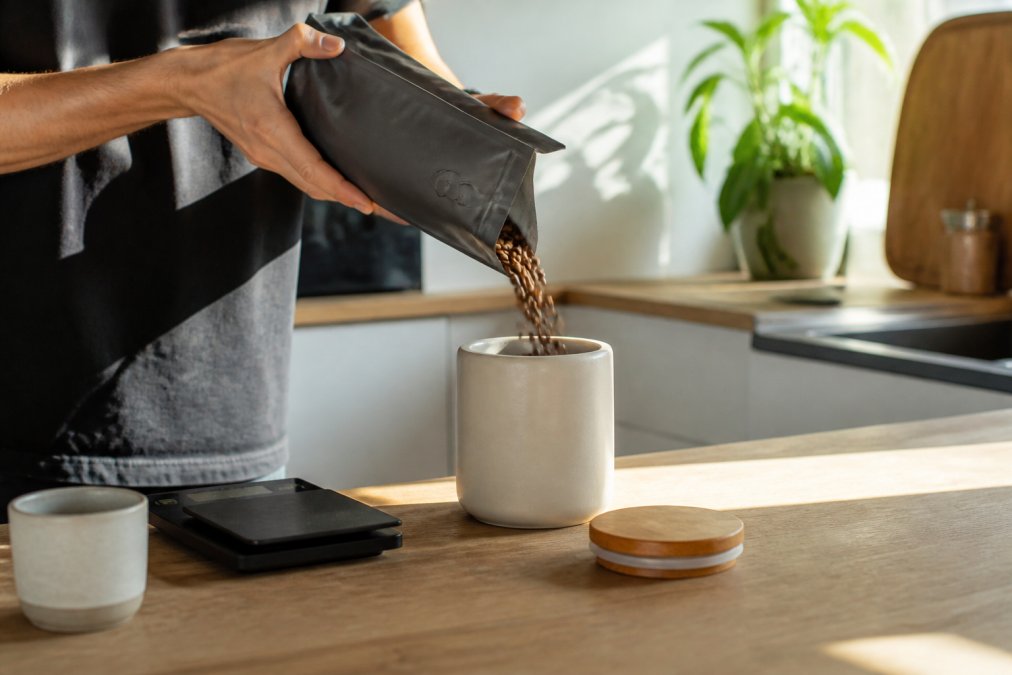
The best container for fresh coffee is an airtight, opaque one that blocks oxygen and light. A clear glass jar on your counter looks nice, but it lets UV light through and speeds up staling.
What Makes a Container Work
Four features matter most:
- Airtight seal to keep oxygen out
- Opaque walls to block UV light
- One-way valve to release carbon dioxide
- Right size to limit empty space
That one-way valve is the detail people skip. Fresh beans release carbon dioxide as they degas (pubmed.ncbi.nlm.nih.gov). A valve lets that gas escape without letting oxygen back in.
Step 2: How Long Does Coffee Stay Fresh After Roasting?
Whole bean coffee stays fresh for about two to four weeks after the roast date when stored in an airtight container. Ground coffee goes stale much faster, often within a week.
Reading the Roast Date
A roast date tells you more than a "best by" label ever will. The roast date marks when the clock starts. Peak flavor usually lands a few days after roasting and holds for a short window.
Check the bag the moment it arrives. If there's no roast date, you're guessing.
Step 3: Choose the Best Coffee Storage Canisters for Your Kitchen
The best coffee storage canisters combine an airtight seal with opaque walls and a one-way valve. Material matters here, and it's a detail most guides skip. The table below is a starting point, but the real decision comes down to how each material handles light, oxygen, and static.
| Canister Type | Blocks Light | Airtight | Static Buildup | Best For |
|---|---|---|---|---|
| Ceramic | Yes | Yes (with gasket) | None | Countertop display |
| Stainless steel | Yes | Yes (with gasket) | None | Daily use |
| Opaque plastic | Yes | Some | High | Budget setups |
| Clear glass | No | Some | Low | Short-term only |
Why Material Science Matters More Than the Label
"Airtight" is a marketing word until you check the gasket. A silicone or rubber gasket is what actually seals the lid; a metal-on-metal or glass-on-glass lid with no gasket will let air in over time. Look for a removable gasket you can wash, because coffee oils build up on silicone and turn rancid.
Light protection is the second variable. UV light doesn't just warm the beans, it breaks down the aromatic compounds that give coffee its character. That's why clear glass loses no matter how tight the lid is. If you already own a clear jar, keep it inside a closed cabinet rather than on an open shelf.
Static is the third variable, and it's the one nobody mentions. Plastic canisters build up a static charge that makes ground coffee cling to the walls and fly when you open the lid. Ceramic and stainless steel don't have this problem. If you grind fresh, this alone is a reason to skip plastic.
The Valve Question
A one-way valve lets carbon dioxide escape while keeping oxygen out. Fresh beans degas for several days after roasting, and without a valve that gas builds up inside a sealed container. Some canisters include a valve; many don't. If yours doesn't, you can still use it, just burp the lid once a day for the first week after the roast date.
A Note on Climate
Where you store the canister matters as much as what it's made of. In humid climates, a gasketed ceramic or stainless canister keeps ambient moisture out; in arid climates, the same canister keeps the beans' own oils from drying out. Either way, keep the canister away from the stove, the sink, and any window that gets direct sun.
Step 4: Can You Freeze Coffee Beans Without Ruining Them?
Yes, you can freeze coffee beans, and it works well when you do it right. Freezing slows oxidation and keeps beans near peak flavor for months. The catch is moisture, specifically, the condensation that forms when a cold bag meets warm room air.
Why Condensation Is the Real Enemy
When you pull a sealed bag from the freezer and open it immediately, warm humid air rushes in and condenses on the cold beans. That surface moisture doesn't just make the beans damp; it accelerates the chemical reactions that stale coffee. The fix is simple: never open a cold bag. Let it come to room temperature sealed, then open it.
Portion Before You Freeze
Freeze beans in portions you'll use in a week or less. A vacuum seal or airtight bag with the air pressed out works best. If you're using a zip-top bag, press out as much air as you can before sealing, a straw helps.
The reason portioning matters: every time you open the bag to scoop out beans, you expose the whole batch to room air.
The Post-Freezing Workflow
Follow this order every time:
- Pull the portion you need from the freezer
- Leave it sealed on the counter for a few hours, overnight is fine
- Wait until it hits room temperature
- Open only after it's fully thawed
- Grind and brew right away
If you're in a hurry, you can run the sealed bag under cool water, but never warm water and never the microwave. Rapid temperature change is what causes condensation.
What Freezing Does and Doesn't Fix
Freezing pauses the clock on oxidation, but it doesn't reverse staling that already happened. Beans that were already a month past roast when you froze them won't come back. Freeze within a few days of the roast date for the best result.
Step 5: Control Light, Heat, and Moisture in Any Climate
Heat, light, and moisture are the three forces that stale coffee fastest. Beat all three and your beans last far longer.
Where you live changes the plan:
- Humid climates: keep beans in a sealed canister away from the stove and sink
- Dry climates: seal tightly so beans don't dry out
- Hot climates: store in a cool pantry, not above the fridge
Step 6: Store Whole Bean vs. Ground Coffee Differently
Whole bean coffee holds its flavor far longer than ground coffee because the surface area is smaller. Grinding exposes more of the bean to oxygen, so ground coffee stales within days.
Step 7: Travel and Small-Batch Storage Solutions
Travel storage is the gap most guides ignore. On the road, you want small, sealed, and light-blocking.
Try these:
- A small vacuum-sealed bag for the trip
- A single-serve airtight tube for daily doses
- A hard-sided case to stop crushing in a bag
Frequently Asked Questions
How long do fresh coffee beans stay fresh?
Whole bean coffee hits peak flavor 4 to 14 days after the roast date and stays good for about 3 to 4 weeks in a sealed container. After that, oxidation and degassing flatten the aroma. Ground coffee loses its edge in days, not weeks, because the surface area exposed to oxygen is far greater. Check the roast date on the bag, not the best-by date, and buy in batches you can finish within a month.
Is it okay to store coffee beans in a Ziploc bag?
A Ziploc bag keeps beans for a few days at best. The plastic is thin, oxygen passes through it over time, and you cannot press out all the air before sealing. For a short trip or a small batch you will brew within a week, it works in a pinch. For everyday storage, move beans to an airtight, opaque container or keep them in the original one-way valve bag with the air squeezed out.
Does freezing coffee beans actually keep them fresh?
Yes, if you do it right. Freezing slows the oxidation that dulls flavor, and research on cold storage shows beans kept frozen retain more of their aroma compounds than beans left at room temperature. The catch is moisture. Use an airtight, opaque container, freeze in small portions you will use in one or two weeks, and never refreeze beans after they thaw. Condensation is the enemy here, not the cold.
What are the four enemies of coffee freshness?
Oxygen, light, heat, and moisture. Oxygen reacts with the oils in roasted beans and turns them stale. UV light breaks down volatile compounds that carry aroma. Heat speeds up every chemical reaction, including the ones you want to slow down. Moisture, whether from humidity or condensation, clumps grounds and muddies the flavor profile. An airtight, opaque container in a cool, dark place handles all four at once.
Storing coffee well takes a few small habits, not a lot of gear. The challenge is staying consistent when life gets busy. That's where Happy Pup Coffee Company helps. As a veteran-owned and operated business, we roast in small batches and ship specialty-grade coffee straight to your door, so every bag arrives fresh. Choose from single-origin favorites, flavored blends, or convenient single-serve capsules. Get started with Happy Pup Coffee Company and keep peak flavor in every cup.