


Table of Contents
- Start With Your Brewing Setup
- Match Delivery Frequency to How Fast You Drink
- Coffee Roast Profiles Explained: Find Your Flavor Match
- A Fresh Coffee Beans Delivery Service Solves the Staleness Problem
- Coffee Subscription vs Buying Bags: Which Costs Less Per Cup?
- Check Flexibility: Pausing, Swapping, and Canceling
- Sustainability and Storage: What Happens After Delivery
- Frequently Asked Questions
Last Updated: September 30, 2026
Start With Your Brewing Setup
Learning how to choose a coffee subscription box starts with one question most buyers skip entirely: what equipment will actually brew the coffee? According to Specialty Coffee Association brewing standards, grind size and brew method determine how much flavor you extract from any bean, so your setup should drive every decision that follows. This guide from Happy Pup Coffee Company walks through grind format, delivery frequency, roast profiles, cost per cup, and flexibility, in the order that matters.
Whole Bean vs. Pre-Ground vs. Capsules
Whole bean coffee stays fresh longest because the oils and aromatics remain sealed until you grind it. Pre-ground is convenient but loses aroma within days. Capsules trade flexibility for speed and consistency.
Match the format to your equipment:
- Whole bean: drip machines with a burr grinder, pour-over, French press, espresso
- Pre-ground: standard drip machines when you have no grinder and want minimal effort
- Capsules: single-serve machines at home or in an office, no grinding or measuring required
Match Delivery Frequency to How Fast You Drink
Delivery frequency should match your actual consumption rate, not an aspirational one. A home brewer using 2 tablespoons per cup goes through roughly 12 ounces every two weeks; a one-cup-a-day drinker stretches the same bag to about a month. Ordering faster leaves stale bags; slower means gaps without coffee.
Weekly, Biweekly, or Monthly Delivery
Use this table to map your habit to a schedule:
| Your Daily Cups | Recommended Frequency | Approximate Bag Size |
|---|---|---|
| 1 cup | Monthly | 12 oz |
| 2-3 cups | Biweekly | 12 oz |
| 4+ cups or office use | Weekly | 12-16 oz |
Coffee Roast Profiles Explained: Find Your Flavor Match
Coffee roast profiles describe how long and how dark a roaster develops the beans, shaping acidity, body, and sweetness. Light roasts keep more of the bean's original character, medium roasts balance sweetness and acidity, and dark roasts push toward cocoa, caramel, and smoke. Roast level matters more than origin for most casual drinkers, though origin determines the underlying flavor profile.
- Light roast: bright, fruity, floral; best for pour-over
- Medium roast: balanced, sweet, nutty; the safest all-around pick
- Dark roast: bold, bittersweet, low acidity; shines in espresso and French press
A Fresh Coffee Beans Delivery Service Solves the Staleness Problem
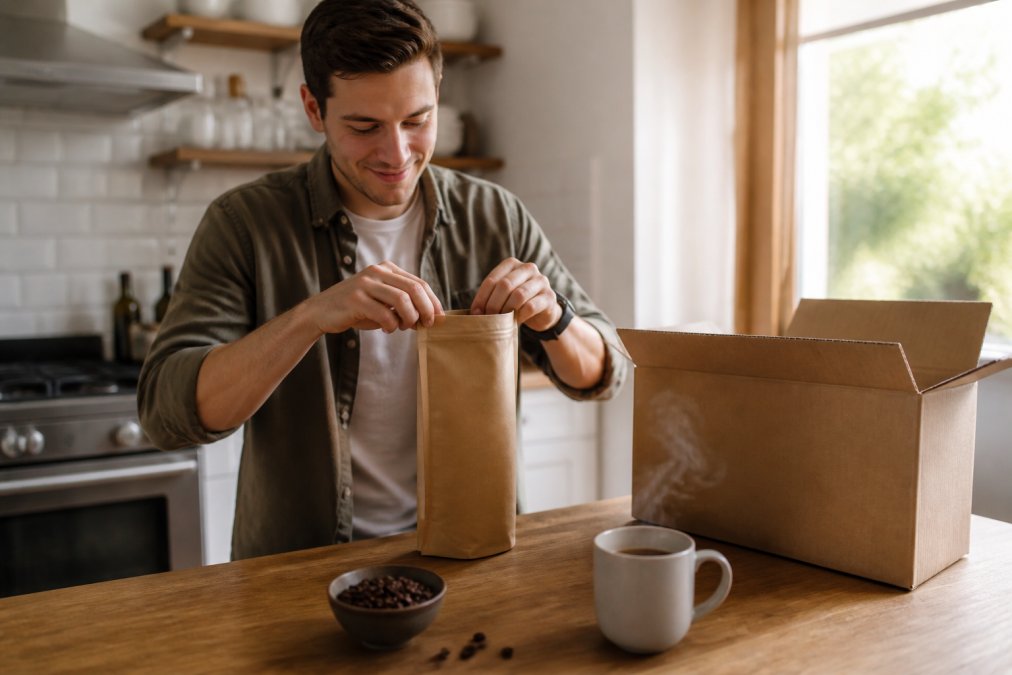
A fresh coffee beans delivery service ships coffee shortly after roasting rather than after months on a shelf. Once roasted, coffee releases carbon dioxide and takes in oxygen, and most of the aroma you paid for is gone within weeks. Grocery bags often carry no roast date, so you cannot know how old the coffee is.
Coffee Subscription vs Buying Bags: Which Costs Less Per Cup?
The coffee subscription vs buying bags comparison rarely comes down to sticker price, because the two options are not selling the same thing. A grocery bag is cheaper per ounce but often older and lower grade; a subscription costs more per bag while delivering fresher, specialty-grade beans. The fair comparison is cost-per-cup, not cost-per-bag, and the only way to make it honestly is to run the numbers on your own habit.
The Cost-Per-Cup Formula
Use the same inputs every time so the comparison is apples to apples:
- Dose per cup. A standard drip cup uses about 2 tablespoons, roughly 10-12 grams; a double espresso about 18 grams; a French press mug often 20-25 grams. Pick the number that matches how you brew.
- Yield per bag. Divide the bag weight by your dose. A 12-ounce bag (340 grams) yields roughly 28-34 drip cups at 10-12 grams each, or about 18 double espressos at 18 grams.
- Landed cost. Add shipping, tax, and any subscription fee to the bag price before dividing. A $20 bag with $6 shipping is a $26 bag.
- Waste factor. Multiply your cup count by the share of the bag you actually finish before it goes flat. Toss the last quarter of every bag and your real cost per enjoyable cup is roughly a third higher than the sticker math.
A Worked Example
Say you drink two 12-gram drip cups a day, about 24 grams daily, or roughly 720 grams a month, a little over two 12-ounce bags.
- Grocery route: two 12-ounce bags at $12 each, no shipping, but no roast date and unknown age. Landed cost: $24. If you finish both bags, that is about $0.50 per cup.
- Subscription route: two 12-ounce bags at $19 each plus $5 flat shipping. Landed cost: $43. If you finish both bags, that is about $0.90 per cup.
When a Subscription Loses on Cost
A subscription is the wrong financial call in three situations:
- You drink fewer than about one cup a day. A single 12-ounce bag will stale before you finish it, so you pay a freshness premium you cannot capture.
- You brew capsules only. Pod pricing is set by the machine ecosystem, not by roast freshness, so a bean subscription does nothing for your per-cup cost.
- You genuinely enjoy grocery coffee. If you cannot taste the difference, the premium buys you nothing.
When a Subscription Wins on Cost
A subscription wins when freshness translates into cups you actually finish. Three patterns show up repeatedly:
- You drink two or more cups a day. Higher volume means faster turnover, so fresher beans reach your grinder before they fade.
- You brew espresso. Espresso amplifies staleness, older beans pull thin, gassy shots, so the freshness premium shows up directly in shot quality.
- You were already buying specialty bags. If your grocery or local roaster already charges $18-$22 a bag, a subscription at a similar price with a guaranteed roast date is close to cost-neutral.
Check Flexibility: Pausing, Swapping, and Canceling
Flexibility is where subscriptions earn or lose their keep. Before you enter payment details, confirm three things: whether you can pause without losing your place, whether you can swap roasts or origins between shipments, and what the cancellation policy says. A plan that locks you into a fixed auto-renew cycle with no pause option is one you will resent by month three.
Best Sellers Sample Pack: 6Bean →
- Flexible plans that let you skip a shipment
- Easy swaps between single-origin and blend offerings
- A stated cancellation window with no hidden fees
Sustainability and Storage: What Happens After Delivery
Sustainability and storage are the two angles most coffee subscription guides skip, and both affect whether your money was well spent. On sourcing, terms like direct trade and fair trade describe how beans were purchased, and small-batch roasting usually means tighter quality control. On storage, how you treat the bag determines whether week four tastes as good as week one.
How to Verify Ethical Sourcing Claims
Certification logos and marketing language are not the same thing. Use this three-tier check, from strongest evidence to weakest:
Tier 1, Third-party certification with a traceable certificate.
- Fair Trade Certified (Fair Trade USA) and Fairtrade International both maintain searchable databases of certified producers and licensed brands. If a roaster claims certification, the brand should appear in the certifier's public licensee list.
- USDA Organic is a legally defined label enforced by the USDA National Organic Program. USDA organic labeling standards explains what the seal does and does not cover, note that 'organic' addresses farming inputs, not farmer pay.
- Rainforest Alliance and Bird Friendly (Smithsonian Migratory Bird Center) are additional third-party programs with public standards.
Questions to Ask Before You Subscribe
- Does the product page name the farm, cooperative, or importer?
- Is there a certification logo, and does the certifier's public database list this brand?
- Does the roaster publish a sourcing or transparency report?
- Is the roast date printed, or only a 'best by' date?
- Does the packaging disclose recyclability or compostability of the bag itself?
If a provider answers two or three of these clearly, that is a stronger signal than any single badge.
Storage: Managing Bulk Deliveries Without Losing Freshness
A subscription that ships faster than you drink creates a storage problem, and storage is where most of the freshness you paid for disappears. The enemies are oxygen, light, heat, and moisture.
Container choice.
- Best: opaque, airtight, one-way-valve canister stored in a cool, dark cabinet. The valve lets carbon dioxide escape without letting oxygen in.
- Acceptable: the original bag, rolled tight and clipped, if it has a valve and a roast date.
- Avoid: the refrigerator. Condensation cycles and food odors migrate into the beans. The freezer is a different story, see below.
Rotation system for weekly or biweekly deliveries.
- Label each bag with its roast date on arrival.
- Drink oldest first, first in, first out.
- Keep one bag in the cabinet and freeze the rest in weekly portions.
- If you fall behind by more than a bag, pause the next shipment rather than stacking inventory.
Packaging and End-of-Life
Sustainability does not stop at the farm. Most coffee bags are multi-layer laminates that municipal recycling programs will not accept. Look for roasters using recyclable mono-material bags, compostable packaging, or a bag-return or refill program. A roaster that publishes its packaging materials usually also publishes its sourcing.
Use this checklist before you commit to any plan:
- Roast date printed on the bag
- Brew format matches your equipment
- Delivery frequency matches your real consumption
- Pause, swap, and cancel terms stated clearly
- Sourcing information available on the product page
- Certification verifiable in the certifier's public database
- Packaging end-of-life disclosed
Frequently Asked Questions
Are coffee subscription boxes worth it compared to buying bags at the store?
It depends on how much you value freshness and variety. Grocery store beans often sit on shelves for months, while a coffee subscription ships within days of roasting. Per-cup cost varies by plan and grind type, but subscriptions typically range from $0.50 to $1.50 per cup. If you drink coffee daily and care about flavor, a subscription usually delivers better quality for a similar or slightly higher price.
How do I determine my preferred coffee roast profile?
Start with a sample pack that includes light, medium, and dark roasts. Light roasts tend to be fruity and acidic, medium roasts balance sweetness and body, and dark roasts lean smoky and bold. Pay attention to tasting notes on the bag, like chocolate, citrus, or caramel. After a few weeks of trying different roasts, you will notice which flavor profile you reach for most often.
Should I choose whole bean or pre-ground coffee for a subscription?
Whole bean stays fresh longer because the oils and aromatics are protected until you grind. If you have a burr grinder and brew within a week or two, whole bean is the better choice. Pre-ground works well for drip machines or if you lack a grinder, but plan to use it within seven to ten days. Single-serve capsules offer the most convenience and are sealed to preserve freshness.
What should I check before committing to a coffee subscription?
Look at four things: delivery frequency options, roast level customization, pause or cancel policy, and shipping costs. A flexible plan lets you skip a month or swap roasts without penalties. Also confirm the roast date is printed on the bag, not just a best-by date. If you brew with a specific machine, verify the subscription offers compatible grind sizes or capsules.