


Table of Contents
- The Cost of Specialty Coffee Per Cup: Home vs. Cafe
- How to Calculate Coffee Cost Per Cup
- The Coffee Brewing Ratio for Specialty Beans
- Specialty Coffee Price Per Pound: What Drives the Number
- How Your Brewing Method Changes the Cost Per Cup
- Hidden Costs: Equipment, Water, and the Environment
- Conclusion
- Frequently Asked Questions
Last Updated: September 18, 2026
The Cost of Specialty Coffee Per Cup: Home vs. Cafe
The cost of specialty coffee per cup swings from roughly a dollar at home to several times that at a cafe, and the gap comes down to labor, rent, and markup rather than bean quality. At Happy Pup Coffee Company, we roast specialty-grade beans and ship them fresh, so we watch this math closely. This breakdown shows what you actually pay per cup in 2026, how to calculate it for any brewing method, and which costs most people overlook.
The Price of Convenience: What You Pay at the Cafe
A cafe cup carries everything a home cup does not. You pay for the barista's wages, the storefront lease, the espresso machine, the point-of-sale system, and the owner's margin. None of that is waste, but all of it lands in your cup.
Specialty cafes also price higher because their green coffee costs more. A shop serving single-origin lots pays wholesale prices well above commodity-grade contracts, and it passes part of that through.
The trade-off is straightforward: you are buying consistency, atmosphere, and someone else's labor. If you drink two or more cups a day, that convenience premium compounds quickly, which is why so many remote workers eventually buy their own gear.
The Home Brewing Advantage
Brewing at home removes labor and rent from the equation entirely, leaving beans, water, filters, and equipment depreciation. Those are the only inputs you control, and they are the only ones that matter for your true cost.
The savings are real but they are not automatic. A home setup only beats a cafe when you actually use it, and equipment you abandon after a month is the most expensive coffee you will ever buy. Buy gear that matches your routine, not the routine you wish you had.
How to Calculate Coffee Cost Per Cup
To calculate coffee cost per cup, divide the price of your bag by the number of grams in it, multiply by the grams you dose per cup, then add your filter, water, and equipment costs. That gives you a real number instead of a guess.
The steps:
- Note your bag price and its weight in grams (a 340 g bag is common).
- Divide price by grams to get cost per gram.
- Multiply cost per gram by your dose (typically 15-18 g for a mug).
- Add filter paper, water, and a per-cup share of equipment cost.
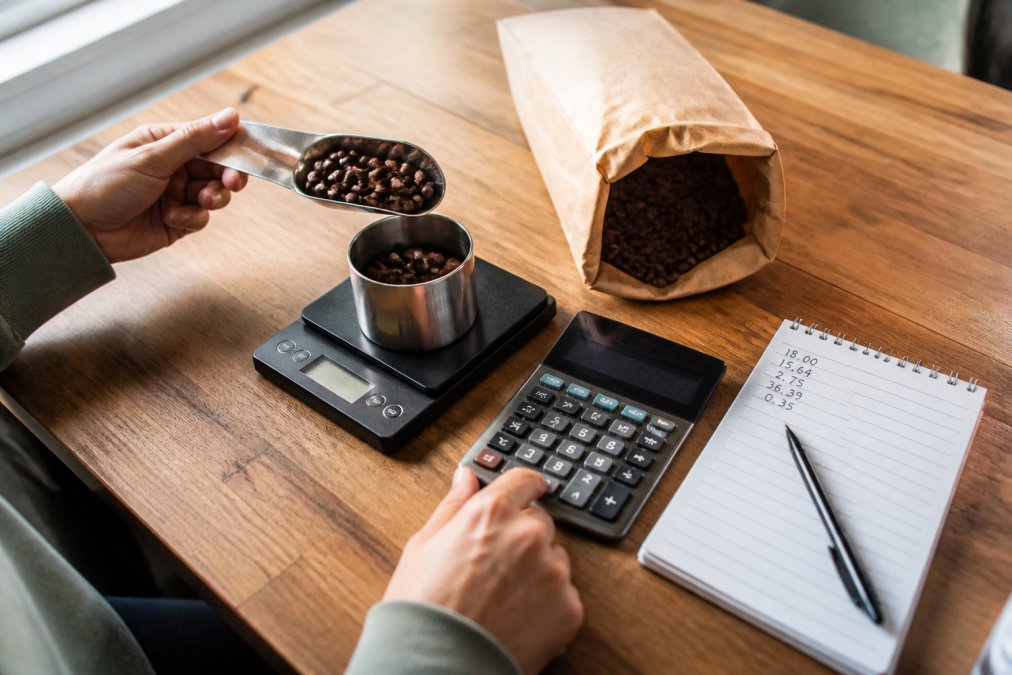
The Simple Formula for Any Brewing Method
The formula works for every method because it only asks two questions: how much coffee, and how much did that coffee cost? Everything else is an add-on.
Cost per cup = (bag price ÷ bag grams) × dose in grams + consumables.
If a bag costs $19.99 for 340 g, that is about 5.9 cents per gram. A 16 g dose lands near 94 cents, before filters or water. Run the same math on your current grocery-store bag and the comparison stops being abstract.
The Coffee Brewing Ratio for Specialty Beans
The coffee brewing ratio for specialty beans is the weight of coffee to weight of water, and it drives both flavor and cost. A common starting point is 1:15 to 1:17, meaning one gram of coffee to 15-17 grams of water.
Ratios matter for budgeting because a stronger ratio uses more beans per cup.
Specialty Coffee Price Per Pound: What Drives the Number
Specialty coffee price per pound reflects origin, processing, freshness, and how many hands the beans pass through before reaching you. A 340 g bag at $19.99 works out to roughly $26.65 per pound, which sits in the normal range for freshly roasted specialty-grade coffee.
Several variables push that number up or down:
- Origin and altitude: Higher-grown lots from regions like Chiapas or Piura often command more.
- Processing method: Washed and experimental processes add labor.
- Roast freshness: Coffee sold within days of roasting costs more to move quickly.
- Volume: Larger packs lower your unit price without changing quality.
The Cost of Single-Origin vs. Blends
Single-origin lots trace to one region and often one cooperative, while blends combine several coffees for consistency. Single-origin tends to cost more per pound because small lots carry higher sourcing costs and less flexibility.
How Your Brewing Method Changes the Cost Per Cup
Brewing method changes cost per cup through three levers: dose size, consumables, and equipment overhead spread across the life of the gear. Two methods can use the same beans and land 40 cents apart per cup once you account for all three.
| Method | Typical Dose | Bean Cost/Cup | Consumables/Cup | Equipment/Cup (2-yr amortized) | All-In Cost/Cup |
|---|---|---|---|---|---|
| Espresso | 18-20 g | $1.06-$1.18 | ~$0.01 (occasional descaler) | $0.55-$1.10 (machine $400-$800) | $1.62-$2.29 |
| Pour over | 15-18 g | $0.89-$1.06 | $0.02-$0.04 (paper filter) | $0.07-$0.14 (dripper $50-$100) | $0.98-$1.24 |
| French press | 20-25 g | $1.18-$1.48 | $0.00 | $0.03-$0.05 (press $20-$40) | $1.21-$1.53 |
| Capsules | Fixed (~12 g) | $0.70-$1.00 | $0.00 | $0.05-$0.15 (brewer $60-$200) | $0.75-$1.15 |
Espresso, Pour Over, French Press, and Capsules
Espresso concentrates 18-20 g into a 30-40 g shot. Bean cost per shot sits near a dollar, but a $400-$800 machine spread over two years of daily use adds roughly 55 to 110 cents per shot. Skip the machine and the math flips entirely in espresso's favor.
Dosage Variance by Roast Profile: The Cost Most Guides Skip
Here is the angle almost no cost guide covers: the same scoop of light roast and dark roast does not weigh the same, so your cost per cup shifts with the roast even when the bag price does not.
Hidden Costs: Equipment, Water, and the Environment
Equipment depreciation is the cost most home brewers forget. A $150 grinder, a $20 scale, and a $60 brewer spread across two years of daily cups add roughly 30 to 35 cents per serving, but only if you actually use them. Abandoned gear is the most expensive coffee you will ever own, because the per-cup math never gets a chance to amortize.
Water Quality and Filtration: The Cost Nobody Counts
Water is the ingredient every cost guide ignores, and it is not free once you care about flavor. Tap water varies widely by municipality, hardness, chlorine, and mineral content all affect extraction, and hard water scales every machine it touches.
The Environmental Cost vs. the Financial Cost
Most cost-per-cup guides stop at pennies. The environmental ledger is a second column worth reading.
A Five-Year Price Trend: What Inflation Did to Your Cup
Specialty coffee has not been immune to the broader rise in food prices. Green coffee is a globally traded commodity, and the C-price benchmark on the ICE futures exchange has swung widely over the past five years, driven by weather in major growing regions, shipping costs, and currency moves. Roasters pass some of that through and absorb the rest.
Conclusion
Working out the true cost of specialty coffee per cup takes ten minutes and changes how you buy coffee for years. Happy Pup Coffee Company is veteran owned and operated, roasts specialty-grade beans, and delivers them fresh to your doorstep, with single-origin options like our Mexico Coffee Pods and blends built for daily drinking. Start your day energized and end it in pure relaxation.

Frequently Asked Questions
How much does a cup of specialty coffee cost when brewed at home?
Brewing at home typically costs between $0.50 and $1.50 per cup, depending on the beans and method. For example, a 12 oz bag of specialty beans priced at $18 and yielding about 16 cups works out to roughly $1.13 per serving. Single-serve capsules can bring that cost down further. This is significantly less than the $4 to $6 you would pay for a comparable cup at a cafe.
What is the 15-15-15 coffee rule?
The 15-15-15 rule is a simple guideline for consistent coffee: use 15 grams of coffee per 15 ounces of water, and brew for 15 minutes in a cold brew setup. For hot brewing, the timing changes but the ratio holds. It is a starting point, not a strict law. Adjust the coffee brewing ratio for specialty beans based on roast profile and your taste preferences.
Does the brewing method affect the cost per cup of specialty coffee?
Yes. Espresso uses about 18 to 20 grams of coffee per shot, while a pour over uses 15 to 20 grams for a larger cup. French press typically uses 20 to 25 grams for a 12 oz serving. Capsules lock in a fixed cost per serving. The method changes both the dosage and the equipment overhead, which shifts your final cost per cup.
Why is specialty coffee so expensive in 2026?
Specialty coffee prices reflect green bean costs, roast profile precision, freshness, and supply chain volatility. The retail price index for coffee has risen due to climate impacts on growing regions and higher shipping costs. Specialty-grade beans also require more labor and quality control than mass-market coffee. A 12 oz bag of specialty coffee often costs $15 to $25, which still delivers a lower cost per cup than most cafes.
The challenge is not finding cheap coffee, it is finding coffee worth the price you pay. Happy Pup Coffee Company roasts specialty-grade beans fresh and ships them directly, backed by veteran ownership and single-serve capsules that fit standard machines. Browse the full collection and let the per-cup math speak for itself.