


Table of Contents
- Fresh Roasted Coffee vs Instant Coffee Health: A Direct Comparison
- How Processing Methods Shape the Final Cup
- Antioxidant Levels in Coffee: Fresh Beans vs Soluble Granules
- Caffeine Content, Acrylamide, and Other Health Markers
- How to Choose Coffee Beans for Better Health Outcomes
- Blood Pressure, Heart Rate, and the Convenience Trade-Off
- Gut Microbiome and Environmental Impact: What Competitors Miss
- Conclusion: Which Cup Fits Your Health Goals?
- Frequently Asked Questions
Last Updated: September 29, 2026
Fresh Roasted Coffee vs Instant Coffee Health: A Direct Comparison
Fresh roasted coffee vs instant coffee health is a comparison that comes down to processing, not marketing. Fresh roasted beans retain more chlorogenic acid and polyphenols because they skip the harsh extraction and drying steps that define soluble coffee. This guide from Happy Pup Coffee Company breaks down what actually changes between the two cups, and where the health trade-offs land.
Instant coffee is a soluble coffee product made by brewing ground coffee and then drying the resulting extract into granules or powder. That extra step is where most of the differences begin. Below, we'll show you exactly how processing, antioxidants, caffeine, and even gut health shift between fresh beans and a spoonful of granules.
How Processing Methods Shape the Final Cup
Processing decides almost everything about what ends up in your mug. Fresh roasted coffee is ground and brewed once, so the compounds in the bean transfer directly to the cup. Instant coffee goes through roasting, grinding, extraction, and then either spray-dried or freeze-dried into soluble coffee.
Freeze-dried instant tends to hold onto more aroma and some heat-sensitive compounds than spray-dried versions, because it uses lower temperatures during drying. Spray-dried instant is cheaper to make but loses more of the delicate volatile oils during the process.
The practical takeaway: fewer processing steps generally mean more of the original bean chemistry survives. Roasting itself matters too. A medium roast tends to preserve more chlorogenic acid than a dark roast, which is one reason roast level shows up in every coffee health conversation.
Antioxidant Levels in Coffee: Fresh Beans vs Soluble Granules
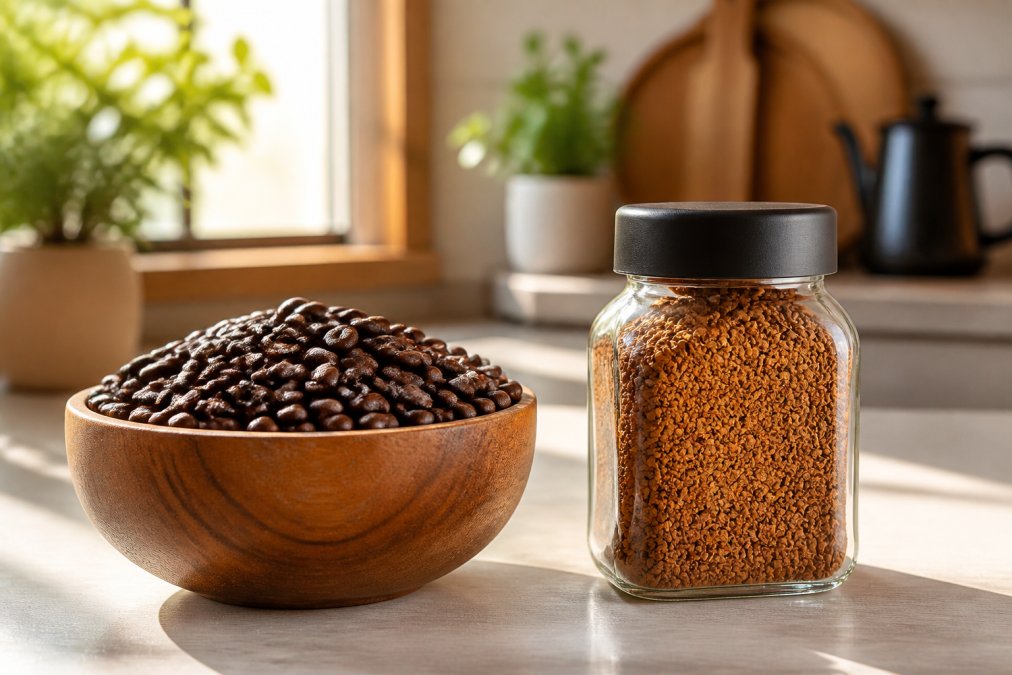
Antioxidant levels in coffee are highest in freshly roasted, freshly brewed beans. The main antioxidants in coffee are polyphenols, and chlorogenic acid is the most studied among them. Both are sensitive to heat, oxygen, and time.
Chlorogenic Acid and Polyphenol Retention
Chlorogenic acid retention drops as coffee is processed, stored, and exposed to oxygen. Fresh roasted beans that are brewed soon after roasting hold more of it. Instant coffee loses a meaningful share during the high-heat extraction and drying stages.
That does not make instant coffee antioxidant-free. It still contains polyphenols, just at lower levels than a fresh brew. If antioxidant intake is your priority, fresh roasted beans brewed at home give you more of what you're after.
Caffeine Content, Acrylamide, and Other Health Markers
Caffeine content is driven by dose and bean type far more than by format, but the two formats do land in different ranges in practice. A standard 8-ounce brewed cup of arabica coffee typically lands around 95 mg of caffeine, while the same volume of instant coffee commonly falls in the 30-70 mg range because instant is often made from a lighter dose of soluble solids per cup. Robusta beans carry roughly twice the caffeine of arabica, so an instant product blended with robusta can close that gap fast. The practical point: if you are tracking milligrams, measure your scoop or pod, not the format.
Acrylamide forms through the Maillard reaction when coffee beans are roasted, it is a byproduct of browning, not an additive, and it appears in both fresh and instant coffee. Roast level is the biggest lever: darker roasts generally produce more acrylamide than lighter roasts, and the compound also forms in toasted bread, french fries, and other browned foods. The FDA guidance on acrylamide in food explains how the agency monitors acrylamide across the food supply and what it considers a reasonable intake range. Neither fresh nor instant coffee is acrylamide-free, but neither is a standout outlier versus other roasted foods.
What the Research Says About Mycotoxins and Mold
Mycotoxins, chiefly ochratoxin A and, less commonly, aflatoxins, are compounds some molds produce when green coffee beans are stored warm and damp before roasting. This is a sourcing and storage issue, not a fresh-versus-instant issue: both formats can carry detectable levels if green beans were mishandled, and both are largely cleared by proper roasting and quality control. The FDA guidance on mycotoxins in food outlines how these compounds are monitored in the food supply, and importers of green coffee are subject to those standards. What actually reduces your exposure is buying from roasters who can speak to their green-coffee sourcing, moisture control, and lot testing, not the format on the label.
How to Choose Coffee Beans for Better Health Outcomes
Choosing coffee beans for health comes down to freshness, roast level, and sourcing transparency. Here's a practical checklist you can use at the store or online:
12 Pack Single Serve Coffee Capsules →
- Check the roast date, not just the expiration date
- Choose a medium roast if you want to preserve more chlorogenic acid
- Buy whole beans and grind just before brewing when possible
- Pick a roaster who shares sourcing and testing details
- Store beans in an airtight container away from light and heat
- Match caffeine level to your sensitivity, not habit
For anyone who wants convenience without giving up freshness, single-serve capsules sealed with no oxygen inside are a middle path. Happy Pup Coffee Company offers 12 Pack Single Serve Coffee Capsules and a 60 Pack Single Serve Coffee Capsules, both built around a signature Original Roast blend with an improved filter design that absorbs more grounds for a fuller cup.


| Factor | Fresh Roasted Beans | Instant Coffee |
|---|---|---|
| Processing steps | Minimal | Multiple |
| Antioxidant retention | Higher | Lower |
| Caffeine control | Precise by dose | Varies by scoop |
| Acrylamide | Present, roast-dependent | Present, roast-dependent |
| Convenience | Requires brewing | Immediate |
| Best for | Flavor and antioxidant focus | Speed and simplicity |
Blood Pressure, Heart Rate, and the Convenience Trade-Off
Most comparisons stop at 'caffeine raises blood pressure' and move on. The useful version of that claim has numbers attached. In adults who do not habitually consume caffeine, a single 200-250 mg dose, roughly two brewed cups, commonly raises systolic blood pressure by about 3-8 mmHg and diastolic by about 2-5 mmHg, with the peak arriving within 30-60 minutes and the effect fading over the next few hours. Heart rate may tick up a few beats per minute at the same time. Habitual drinkers develop partial tolerance to the pressor effect, which is why the same cup hits a daily drinker less than someone who has one coffee a week.
The format does not change the mechanism, caffeine is caffeine whether it arrives from a granule or a ground bean. What changes is how easy it is to overshoot. Instant is scooped by eye, so a heaped teaspoon can quietly deliver more caffeine than the label suggests, while a brewed cup is easier to standardize. For anyone with diagnosed hypertension, arrhythmia, or a sensitivity to stimulants, the practical move is to track total daily milligrams and keep the number consistent, rather than switching formats and hoping for a different result.
A few concrete guardrails help:
- Cap total daily caffeine near 400 mg for healthy adults, the general ceiling cited in federal dietary guidance.
- Avoid stacking caffeine with other stimulants, including pre-workout supplements and energy drinks.
- If you take blood-pressure medication, ask your clinician how caffeine interacts with your specific prescription.
- Watch for sleep disruption, which can raise blood pressure indirectly more than the coffee itself.
For a gentler option, a medium roast like Happy Pup Coffee Company's Breakfast Blend delivers a smooth cup from South American beans without pushing caffeine higher than you need.

Gut Microbiome and Environmental Impact: What Competitors Miss
Brewing method may influence gut microbiome activity, and this is an area where most comparisons stay silent. Polyphenols in coffee act as prebiotic compounds that gut bacteria can ferment. Because fresh brewed coffee retains more polyphenols, it may offer more substrate for that process than instant.
Conclusion: Which Cup Fits Your Health Goals?
If antioxidant intake and flavor are your priorities, fresh roasted beans win. If speed and lower shipping impact matter more, instant has a place. The smartest move is matching the format to your actual routine, not chasing a perfect answer that doesn't exist.
Frequently Asked Questions
What type of coffee is the healthiest?
Fresh roasted coffee generally retains more antioxidants and beneficial compounds than instant. The roasting process affects antioxidant levels in coffee, with medium roasts often preserving higher chlorogenic acid content. Choosing freshly roasted beans from a specialty roaster and brewing with paper filters can reduce certain compounds while keeping the beneficial ones. If convenience matters, single-serve capsules that are sealed to prevent oxidation offer a middle ground.
Are there significant nutritional differences between fresh and instant coffee?
Yes. Instant coffee still provides antioxidants and caffeine. The key difference lies in processing methods.
Does the roasting process affect the antioxidant levels in coffee?
Roasting does affect antioxidant levels in coffee. During coffee bean roasting, chlorogenic acid and other polyphenols change concentration. Light and medium roasts tend to retain more chlorogenic acid, while dark roasts lose some through heat exposure. Fresh roasted coffee, consumed within weeks of roasting, delivers more of these compounds than instant coffee, which undergoes additional processing that further reduces antioxidant content.
Are there downsides to drinking instant coffee regularly?
Instant coffee also often lacks the full spectrum of antioxidants found in fresh beans. Choosing fresh roasted coffee or sealed capsules can help you avoid these trade-offs.
How does processing impact the health profile of instant coffee?
The processing methods affect the health profile of instant coffee.