


Table of Contents
- The Short Answer: Why Single Serve Capsules Don't Fit Every Machine
- Pod Systems Explained: Dimensions, Pressure, and Puncture Style
- How To Check If a Capsule Works With Your Coffee Machine
- How To Use Reusable Coffee Pods for Maximum Compatibility
- Are Single Serve Coffee Capsules Recyclable? What To Know
- Common Mistakes That Damage Your Brewer (and Void the Warranty)
- The Bottom Line: Matching the Capsule to the Machine
- Frequently Asked Questions
Last Updated: September 8, 2026
The Short Answer: Why Single Serve Capsules Don't Fit Every Machine
The honest answer is no, single serve capsules are machine-specific. A capsule designed for one brewing system will not fit or function in another because each manufacturer uses proprietary technology. This guide from Happy Pup Coffee Company explains the technical reasons so you can choose the right pods and avoid wasting money.

Many coffee drinkers buy single serve capsules assuming all pods are interchangeable, only to discover the brewer won't accept them. Compatibility is easy to verify once you know what to look for, and reusable options exist for nearly every machine.
Below, we break down the three main pod systems, show how to check compatibility, and explain how reusable pods offer more flexibility.
Pod Systems Explained: Dimensions, Pressure, and Puncture Style
Single serve capsules fail across machines due to three physical factors: pod dimensions, extraction pressure, and puncture style. Each system is engineered around a specific capsule shape, and the machine's needle, brew chamber, and pump are calibrated to match. If dimensions are off by even a millimeter, the seal breaks and water flows around the coffee.
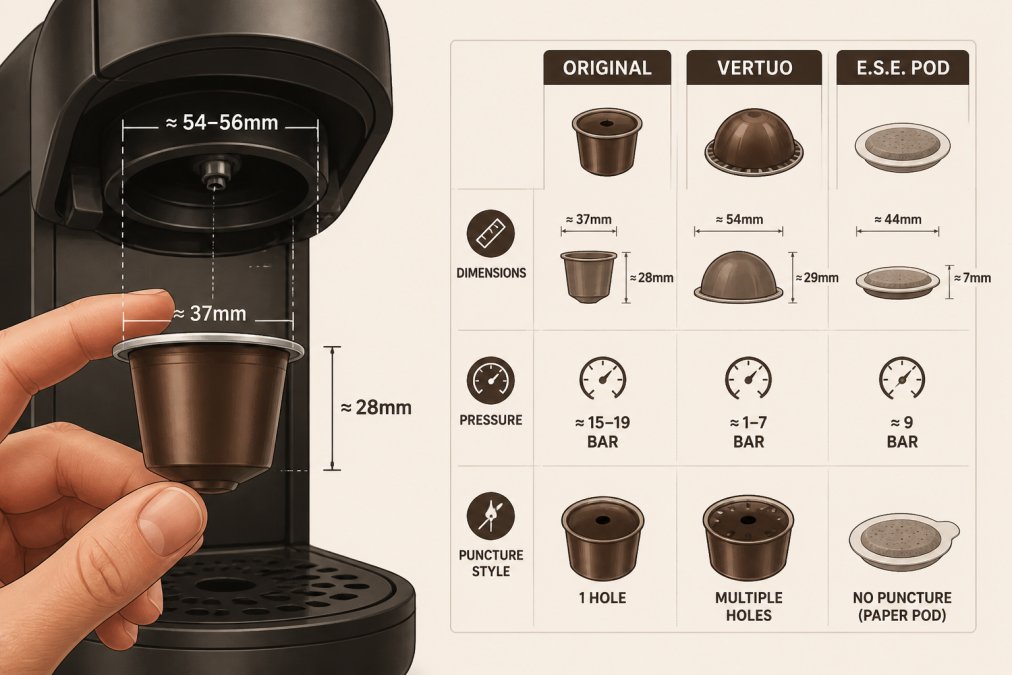
Nespresso OriginalLine vs. VertuoLine
Nespresso operates two incompatible systems under one brand. OriginalLine uses a 40mm capsule brewed at 19 bars, while VertuoLine uses larger, dome-shaped capsules that spin to create crema. A Vertuo capsule will not fit in an OriginalLine machine, and vice versa.
Keurig K-Cup Systems
Keurig brewers use a wider, cup-shaped pod with a foil lid. The machine punctures the top and bottom and forces hot water through at lower pressure than espresso systems. K-Cups are among the most standardized options, but you must check for "Keurig compatible" labeling before buying.
E.S.E. Pods and Other Standards
The E.S.E. (Easy Serving Espresso) standard is the rare exception to proprietary lock-in. These flat, round pods contain 7 grams of pre-tamped coffee between two layers of filter paper and are designed to work in any E.S.E.-compatible espresso machine. The E.S.E. standard was developed by illycaffè to create a universal espresso pod format. While less common in American homes, E.S.E. pods demonstrate that cross-brand compatibility is technically possible when manufacturers agree on a standard.
How To Check If a Capsule Works With Your Coffee Machine
Checking compatibility takes less than a minute:
- Identify your machine model. Look for the model number on the bottom or back of your brewer.
- Find the capsule format. Search your machine's brand and "capsule type" to confirm which pods it accepts.
- Read the packaging. Look for explicit compatibility statements like "works with [brand] machines" on the box.
- Check the pod dimensions. Measure the diameter and height of your current capsule and compare them to the new ones.
- Test one pod before buying in bulk. Purchase a single box or sample pack to confirm the brewing cycle works correctly.
The same logic applies when buying from a new roaster. If you own a Nespresso OriginalLine machine, you need capsules explicitly designed for that system. Many specialty roasters offer compatible pods for popular machines, giving you access to better coffee without a new brewer.
How To Use Reusable Coffee Pods for Maximum Compatibility
Reusable coffee pods solve the compatibility problem entirely by letting you use your own ground coffee in almost any machine. But not all reusable pods are equal, and the material affects both your health and your coffee's flavor.

Material Safety: BPA-Free Plastic vs. Stainless Steel
The two dominant materials for reusable pods are BPA-free plastic and stainless steel. Each has distinct trade-offs that go beyond simple durability.
BPA-free plastic pods are lightweight and inexpensive, typically $8 to $15 for a two-pack. They conduct heat poorly, keeping water temperature closer to the brew temperature. Look for pods made from Tritan or polypropylene, which are FDA-approved for food contact and resist warping. Cheaper plastics may contain phthalates that can leach into coffee at high heat.
Stainless steel pods are heavier and more expensive, usually $12 to $25 for a single pod, but they are virtually indestructible, resist flavor absorption, and are dishwasher-safe. The downside is thermal conductivity: steel heats up quickly, which can slightly drop water temperature. Most users find the difference negligible.
A common pattern among health-conscious coffee drinkers is to avoid plastic entirely. The FDA has set strict limits on BPA in food-contact materials, but the agency's guidance does not cover all the additives that can appear in cheaper imported pods. If you want to eliminate this variable, stainless steel is the safer choice. The FDA's regulatory framework for food-contact substances and BPA safety
Mesh Filter Density: The Hidden Variable
The mesh filter inside a reusable pod determines how much sediment ends up in your cup. A finer mesh (around 100 microns) keeps more grounds out but can slow the brew cycle. A coarser mesh (around 200 microns) brews faster but lets more silt through.
For espresso-style machines like Nespresso OriginalLine, a finer mesh is essential. The 19-bar pressure forces water through quickly, and a coarse filter pushes fines into your cup. For Keurig-style brewers, a medium mesh works well.
Filling and Tamping: Getting the Dose Right
Reusable pods hold between 5 and 7 grams of coffee. Overfilling is the most common mistake. When you pack too much coffee, water cannot saturate the grounds evenly, and the brew channelizes, resulting in a sour, under-extracted shot.
Fill the pod slightly heaping, then tamp with light pressure, about the weight of your thumb. The coffee should sit level with the rim. If the lid does not close flush, you have overfilled it.
Compatibility Verification: Beyond the Marketing Label
Most reusable pod manufacturers list compatible models, but these lists are not always exhaustive. Measure your machine's brew chamber before purchasing. For Nespresso OriginalLine, the chamber is 40mm. For Keurig, it is wider and varies. A pod even 1mm too large can stress the needle and sealing gasket, causing leaks and damage.
Test the pod with water only before adding coffee. Run an empty brew cycle and check for leaks. If water pools or sprays, the pod does not seal correctly, and you should return it.
The Trade-Off: Convenience vs. Control
The main advantage of reusable pods is flexibility: you can use any coffee you like. The trade-off is cleanup. Each pod needs to be emptied and rinsed after every use, adding a minute or two to your routine. For many, that effort is worth controlling freshness and flavor.
Some brands offer stainless steel capsules you fill yourself with commercially available coffee pods. These hybrid systems are rare and often proprietary, so verify compatibility before purchasing.
When shopping for a reusable pod, verify three things: the material is food-safe and BPA-free, the mesh filter is fine enough, and the dimensions match your machine's brew chamber. A poorly fitting pod can cause water to bypass the coffee, producing a weak cup, and over time, it can damage your brewer's pump and sealing mechanism.
Are Single Serve Coffee Capsules Recyclable? What To Know
Whether single serve coffee capsules are recyclable depends on the capsule's construction and your local recycling program. Aluminum capsules, like those in Nespresso OriginalLine machines, are highly recyclable but must be collected separately. Plastic K-Cups require you to peel off the foil lid, empty the grounds, and rinse the cup before recycling.
The environmental impact of single serve capsules has driven brands to develop compostable alternatives. These pods use plant-based materials that break down in industrial composting facilities. Most require the high heat of a commercial composter to decompose properly.
For waste reduction, reusable pods are the most effective option since they eliminate single-use waste entirely. If you prefer the convenience of pre-filled capsules, look for brands that offer mail-back recycling programs or clearly label their packaging with recycling instructions. The EPA provides guidance on recycling programs and composting infrastructure across the United States.
Common Mistakes That Damage Your Brewer (and Void the Warranty)
The most common mistake is forcing a capsule into a machine it wasn't designed for. If a pod doesn't drop in easily, don't push it. Forcing a capsule can bend the needle, damage the brew chamber, and create leaks. Most manufacturers consider this user error, which voids the warranty.
The Universal Adapter Problem
A growing number of third-party sellers offer "universal adapters" that claim to let you use any capsule in any machine. These plastic inserts sit between the capsule and the brew chamber, attempting to bridge the dimensional gap. The reality is that they rarely work as advertised and can cause significant damage.
The fundamental issue is pressure. Nespresso OriginalLine machines brew at 19 bars, while Keurig brewers operate at around 2 to 3 bars. An adapter designed to fit a K-Cup into an OriginalLine machine cannot account for this difference. The high pressure will force water around the adapter's edges, creating leaks that can short-circuit the machine's electronics.
A common pattern is that the first brew cycle seems to work, but the second or third produces a weak cup or no water flow. The adapter's plastic deforms under repeated pressure, and the seal degrades. In some cases, the adapter breaks apart inside the brew chamber, requiring disassembly.
Puncture Pattern Mismatches
Another frequent error involves ignoring the puncture pattern. Nespresso OriginalLine machines use a three-hole bottom puncture system, while Keurig machines use a single top and bottom puncture. If you buy third-party capsules, confirm they match your machine's puncture style. The wrong style can tear the foil or plastic, letting coffee grounds escape into your cup.
For example, a K-Cup-style pod placed in a machine designed for side-puncture will not seal correctly. The side needle pierces the pod's wall at an angle, creating a tear that allows water to bypass the coffee, resulting in hot water with a faint coffee tint and debris in the brew chamber.
Overfilling Reusable Pods and Pump Stress
Using a reusable pod that's slightly too large is a common mistake. A tight fit might seem fine, but the extra pressure can stress the pump and sealing mechanism over time. When a pod is overfilled or oversized, resistance increases, and the pump works harder. Over months, this strain can cause the pump to fail prematurely.
A related issue is using a reusable pod with a mesh filter that is too fine. The fine mesh increases resistance, causing the pump to cycle longer than designed. Some users report brew cycle times doubling or tripling. This extended cycling heats the pump motor and can shorten its lifespan.
Ignoring Descaling Schedules
A less obvious mistake is ignoring the descaling schedule. Single-serve brewers accumulate mineral scale from tap water, which can clog the needle and internal water lines. When scale builds up, pressure drops, and capsules may not brew correctly. Many users mistake this for a compatibility issue when the real problem is a scaled-up machine.
Most manufacturers recommend descaling every three to six months, depending on water hardness. Descaling solutions are available from the manufacturer or as generic citric acid solutions. Following the schedule prevents scale-related damage that manufacturers may classify as user neglect.
The Bottom Line on Damage Prevention
To protect your brewer and your warranty, follow these rules: never force a capsule, avoid universal adapters, verify puncture patterns before buying third-party pods, use reusable pods that are explicitly listed as compatible with your machine model, and descale on schedule. Consumer guidance on maintaining coffee brewers and avoiding common operational errors
If you are unsure whether a capsule or reusable pod is compatible, contact the manufacturer directly. Most brands have customer service lines that can confirm compatibility. A two-minute phone call is cheaper than a $150 repair or a $200 replacement brewer.
The Bottom Line: Matching the Capsule to the Machine
The golden rule is simple: always match the capsule to the machine, never the other way around. Single serve capsules are not universal. Stick with capsules explicitly labeled for your brewer, or switch to reusable pods for maximum flexibility.
| Capsule Type | Machine Compatibility | Refillable Option | Best For |
|---|---|---|---|
| Nespresso OriginalLine | OriginalLine brewers only | Yes | Espresso drinks at home |
| Nespresso VertuoLine | VertuoLine brewers only | Limited | Larger cups with crema |
| K-Cup | Keurig and compatible brewers | Yes | Drip-style coffee convenience |
| E.S.E. Pods | Any E.S.E.-compatible machine | No | Standardized espresso shots |
For coffee lovers who want quality without the compatibility headache, choosing a roaster that clearly labels its capsule compatibility makes all the difference. At Happy Pup Coffee Company, our single serve capsules are designed for standard Nespresso OriginalLine machines, so you know exactly what you're getting before you buy. Each capsule is sealed with no oxygen inside to preserve freshness, and the improved filter design ensures a lively cup without slowing down your brew time.
Choosing the right single serve capsules for your machine doesn't have to be complicated, but it does require attention to detail. At Happy Pup Coffee Company, we make it easy with freshly roasted, specialty-grade coffee delivered to your door, and our capsules are clearly labeled for compatibility. As a veteran-owned business, we're proud to offer coffee that helps you start your day energized. Explore our single serve capsule options and find your new favorite roast
Get started with Happy Pup Coffee Company and enjoy a rich, delicious cup of coffee that fits your machine and your standards.
Frequently Asked Questions
What happens if I try to use the wrong capsule in my coffee maker?
The capsule usually won't fit into the brew chamber, or the machine's needle won't puncture it correctly. Forcing a mismatched capsule can damage the needle or the chamber seal, which may void your warranty. Check the capsule's diameter and height against your machine's specifications before inserting it. If it doesn't seat properly, stop and find the correct size rather than pushing it in.
Are there universal coffee pods available?
Yes, but "universal" typically means the pod uses the E.S.E. (Easy Serving Espresso) standard, which is a flat, round pod of 44 mm diameter. These work in machines that accept E.S.E. pods. Most proprietary systems, like Nespresso VertuoLine or Keurig, do not accept E.S.E. pods. A truly universal single serve capsule that fits every machine does not exist because of differences in pressure, puncture style, and chamber dimensions.
How do I know if a capsule is compatible with my brewer?
Check the packaging for your machine's brand name and model line. Capsules are usually labeled as compatible with specific systems, such as Nespresso OriginalLine or Keurig 2.0. You can also measure your machine's brew chamber. Standard Nespresso OriginalLine capsules are about 37 mm tall, while VertuoLine capsules are larger. When in doubt, contact the capsule manufacturer with your machine's model number.
Can I use reusable coffee pods to make single serve capsules work in any machine?
Reusable pods are made for specific systems, so you still need to match the reusable pod to your machine type. For example, a reusable K-Cup works in Keurig brewers, not in Nespresso machines. Once you have the right reusable pod, fill it with your preferred ground coffee, tamp lightly, and insert it like a regular capsule. This gives you flexibility in coffee choice while keeping the convenience of your single-serve machine.