


Table of Contents
- What Makes Light Roast Coffee Ideal for Pour Over
- Top Light Roast Coffees for Pour Over
- Pour Over Coffee Brewing Tips for Light Roasts
- Why Fresh Coffee Beans Delivery Service Matters
- Advanced Techniques and Troubleshooting
- Conclusion
- Frequently Asked Questions
Last Updated: September 20, 2026
What Makes Light Roast Coffee Ideal for Pour Over
Light roast coffee is roasted for less time and at lower temperatures than medium or dark roasts, preserving more of the bean's original flavors. That's why light roast coffee shines in a pour over brewer: the slow, controlled pour extracts the delicate floral, fruity, and citrus notes a dark roast would burn away. This guide from Happy Pup Coffee Company breaks down which beans work best and how to brew them.
The difference is chemistry: light roasts retain more chlorogenic acid and aromatic compounds, which show up as acidity, floral notes, and flavor clarity. Dark roasts trade those for caramelization and smoke.
Flavor Clarity and Acidity in Light Roasts
Flavor clarity describes how easily you can pick out individual tasting notes. Light roasts offer more clarity because roasting hasn't masked the bean's origin characteristics with roast flavor.
A common mistake is assuming acidity means sour. In specialty coffee it's a positive trait: the bright, lively quality that makes a washed Ethiopian taste like lemon and jasmine rather than ash.
Top Light Roast Coffees for Pour Over
The best light roast coffee for pour over depends on whether you want maximum fruit and floral complexity or a smoother cup. Single origins deliver the most distinctive profiles; blends offer consistency. What most roundups skip is the why: processing method and roast level determine how a bean behaves in a pour over, not just how it tastes.
| Coffee | Roast Level | Process | Tasting Notes | Best For |
|---|---|---|---|---|
| Ethiopia Natural | Medium-light | Natural (fruit dried on bean) | Milk chocolate, fruity, caramel | Bright, fruit-forward cups |
| Tanzania | Medium-light | Fully washed, raised-bed dried | Pear, floral, jasmine, strawberry | Complex, layered flavor |
| Breakfast Blend | Light | Washed, sun dried | Walnuts, mild apple, raisin, toffee | Balanced daily drinking |
How Processing Method Changes the Pour Over
Processing decides how much clarity you get in the cup. Washed coffees ferment the fruit off before drying, producing a cleaner cup where individual notes read distinctly. Natural coffees dry with the fruit on the bean, pushing sweetness and body forward but blurring delicate top notes. In a pour over, washed beans reward precise control with separation between notes; naturals reward it with intensity.

Ethiopia Natural: Fruity and Floral
Happy Pup Coffee Company's Ethiopia Natural comes from smallholder farmers in the Sidama zone, grown at 1,700-1,900 meters and processed using the full natural method, where the fruit dries on the bean before milling. That process is why natural coffees taste so fruit-forward.
Expect milk chocolate, fruity, and caramel notes with a heavier body than a washed coffee; the natural process leaves residual sweetness that balances the acidity.
Tanzania: Bright and Complex
This Tanzania single origin comes from small cooperative farmers in the Mbeya region, fully washed and dried on raised beds. Bourbon and Kent varieties grown at 1,200-1,900 meters produce pear, floral, jasmine, and strawberry notes.

Breakfast Blend: Balanced and Approachable
If you're coming from a grocery store medium roast, start with the Breakfast Blend: a lightly roasted blend of South American coffees with walnut, mild apple, raisin, and toffee notes, washed processed and sun dried.

Single Origin vs. Blend for Pour Over
Single origins showcase a specific place and process, which is why they dominate specialty pour over menus, you taste the terroir, not a roaster's balancing act. Blends smooth out variables: a roaster can compensate for a weak crop by adjusting the mix, so the cup stays consistent bag after bag. Neither is objectively better. Choose single origin to explore and compare; choose a blend for a reliable daily driver you don't have to re-dial every time the roast date changes.
Pour Over Coffee Brewing Tips for Light Roasts
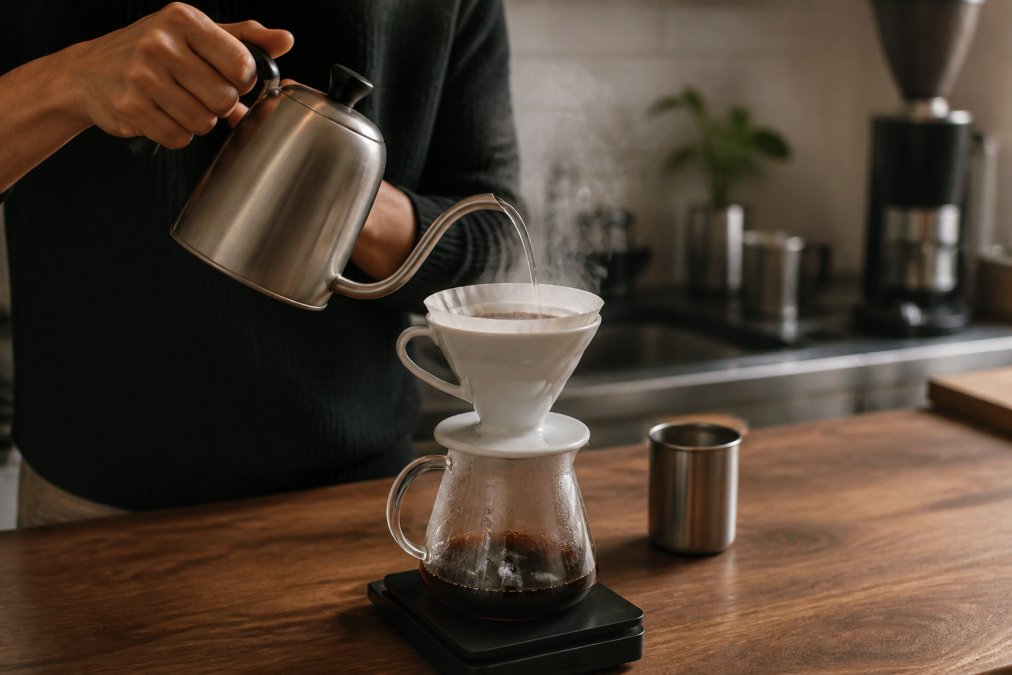
Pour over coffee brewing tips for light roasts start with one rule: hotter water, finer grind, and more patience than you'd use for a dark roast. Light roast beans are denser and less porous, so water struggles to pull flavor out of them. Every adjustment below fixes that, but the two variables most guides ignore are water chemistry and your bean's resting window, and those separate a good cup from a great one.
Grind Size, Water Temperature, and Ratio
Use a medium-fine grind, water between 200-205°F, and a 1:16 brew ratio (about 22 grams of coffee to 350 grams of water). Bloom with roughly twice the coffee's weight in water and wait 30-45 seconds before the main pour.
- Grind size: medium-fine, like table salt. Go finer if the cup tastes weak, coarser if it tastes harsh.
- Water temperature: 200-205°F. Light roasts need the upper end of the range.
- Brew ratio: 1:16 for most light roasts. Tighten to 1:15 for a heavier body.
- Bloom: 30-45 seconds, twice the coffee's weight in water.
- Draw down time: aim for 2:30 to 3:30 total. Faster means the grind is too coarse.
Water Chemistry: The Variable Nobody Talks About
Coffee extracts through water, and what's dissolved in that water determines what gets pulled out of the grounds. Two minerals do most of the work:
- Magnesium binds readily to the fruity and floral acids in light roasts, which is why it amplifies brightness and complexity. Too little magnesium and a washed Ethiopian tastes flat and hollow.
- Calcium extracts more broadly and adds body and sweetness, but in excess it pushes bitterness and astringency forward.
- Alkalinity (bicarbonate) is the buffer that neutralizes coffee's acids. High-alkalinity water mutes the very acidity that makes light roasts worth drinking.
The Resting Period: Why Roast Date Isn't the Whole Story
A visible roast date is essential, but the number on the bag is the starting gun, not the finish line. Light roasts need time to degas, and brewing them too fresh is a common cause of disappointing cups.
- Days 1-3 post-roast: Very fresh light roasts release a lot of carbon dioxide. That CO2 fights water contact during the bloom, causing uneven extraction and a cup that tastes sharp or gassy. Most roasters recommend waiting.
- Days 4-14 post-roast: This is the sweet spot for most light roasts. Degassing has slowed enough for even extraction, but the aromatic compounds are still at their peak.
- Days 15-30 post-roast: The coffee is still drinkable but begins to fade. You may need to grind slightly finer or brew slightly hotter to compensate.
- Beyond 30 days: Aromatic loss dominates. Light roasts have fewer roast-developed flavors to fall back on, so staleness shows up faster than it would in a dark roast.
Why Fresh Coffee Beans Delivery Service Matters
A fresh coffee beans delivery service matters because light roast coffee peaks within days of roasting, not months. The roast date tells you far more than a best-by date, and most grocery store coffee is already weeks old by the time it hits the shelf.
Advanced Techniques and Troubleshooting
Two problems account for most disappointing light roast pour overs: astringency and channeling. Both are extraction issues, both fixable without new equipment.
Fixing Astringency and Channeling
Work through these fixes in order, changing only one variable per brew:
- Coarsen the grind one step if the cup tastes dry or chalky.
- Drop water temperature to 200°F if the finish feels harsh.
- Slow your pour and keep the water level steady to prevent channeling.
- Check your water. Very hard water over-extracts coffee and amplifies astringency, while distilled water under-extracts and tastes flat. A simple filtered water or a mineral-adjusted blend fixes both.
- Shorten the brew by 15-20 seconds if draw down runs long.
Conclusion
Brewing light roast coffee well takes more attention than dumping pre-ground coffee into a drip machine, but the payoff is real flavor clarity instead of uniform bitterness. Start with a medium-fine grind, water near 205°F, and a bean with a visible roast date.
Frequently Asked Questions
What coffee roast is best for pour over?
Light roast coffee is often best for pour over because it preserves delicate flavors and high acidity. Light roasts are denser, requiring a finer grind and higher water temperature (200-205°F) to extract properly. They highlight floral, fruity, and citrus notes that darker roasts mask. For a balanced cup, try Happy Pup's Breakfast Blend, a light roast with walnut and toffee notes.
Can you use light roast for pour over?
Yes, light roast works exceptionally well for pour over. Its density and complex acidity shine when brewed with a slow, controlled pour. Use a medium-fine grind (like table salt), a 1:16 coffee-to-water ratio, and a water temperature around 205°F. Pre-wet the filter and allow a 30-second bloom. This method extracts the bright, clean flavors light roasts are known for.
Why is light roast coffee harder to brew with pour over?
Light roast beans are denser and less porous than dark roasts, making extraction more challenging. They resist water penetration, which can lead to under-extraction and a sour taste if not brewed carefully. To compensate, use a finer grind, higher water temperature, and slower pouring. A longer bloom (45 seconds) helps release trapped CO2.
How does roast level affect pour over extraction?
Roast level directly impacts extraction speed and flavor. Light roasts extract slowly, requiring finer grind and hotter water to pull out sweetness and acidity. Dark roasts extract quickly, so they need coarser grind and cooler water to avoid bitterness. For pour over, light roasts offer more clarity and complexity, while dark roasts provide heavier body and chocolate notes. Choose based on your taste preference.
Note: External citations to authoritative third-party sources (such as the Specialty Coffee Association's brewing standards, USDA organic certification guidance, or FDA food labeling resources) should be verified and inserted at the ... placeholders before publication. Competitor brands were excluded per brand guidelines.