


Table of Contents
- Best Coffee for Home Office: Quick Comparison
- How to Choose the Right Coffee for Your Workspace
- Best Coffee Brewing Methods for Home Office
- Single-Origin vs. Blend: What Works Best
- Caffeine Intake Best Practices for Remote Work
- How to Store Coffee Beans for Freshness
- Sustainability and Ethical Sourcing in Your Daily Cup
- Budget-to-Quality Ratio: Getting Premium Coffee Without Overspending
Last Updated: August 26, 2026
Best Coffee for Home Office: Quick Comparison
The difference between a mediocre morning and a focused workday often comes down to what's in your cup. Remote workers need coffee that delivers consistent energy without jitters, fits a simplified home setup, and doesn't require constant attention. This guide from Happy Pup Coffee Company breaks down how to select the best coffee for your home office, covering roast profiles and brewing methods that work in compact spaces.

Most professionals grab whatever's convenient and wonder why productivity crashes by 2 PM. The real issue is that they're not matching their coffee to their actual workflow. The best coffee for home office work sits at the intersection of three factors: reliable energy, brewing simplicity, and taste you actually enjoy.
| Coffee Type | Best For | Brewing Time | Caffeine Level | Cost Per Cup |
|---|---|---|---|---|
| Medium roast blend | Balanced focus throughout day | 3-5 minutes | Moderate to high | $0.60-$1.00 |
| Single-origin medium | Flavor-forward professionals | 4-6 minutes | Moderate | $0.80-$1.20 |
| Dark roast blend | Afternoon pick-me-ups | 2-3 minutes | High | $0.50-$0.90 |
| Single-serve capsules | Maximum convenience | 1-2 minutes | Moderate to high | $0.70-$1.50 |
| High-caffeine blend | Extended focus sessions | 3-5 minutes | Very high | $0.80-$1.10 |
How to Choose the Right Coffee for Your Workspace
Choosing coffee for your home office means matching the coffee to your actual setup and work rhythm. Start by auditing three things: your brewing equipment, how much time you realistically spend on coffee each morning, and whether you need consistent energy or just a morning jolt.
Your brewing method determines which coffees make sense. A French press tolerates slight variations in technique. An espresso machine requires precision. A simple drip brewer works with almost any grind. Single-serve capsules limit options but collapse prep time to 90 seconds. The best coffee is one you'll actually prepare consistently.
Consider your workday energy pattern. If you need maximum focus for deep work between 9 AM and noon, a higher-caffeine medium roast delivers sustained energy without the harsh edge of dark roasts. If you're managing back-to-back meetings, single-serve capsules let you brew exactly one cup when needed, avoiding stale-coffee problems.
Medium Roast vs. Dark Roast Profiles
Medium roasts retain more origin characteristics, acidity, brightness, and subtle flavor notes. For home office work, medium roasts generally outperform dark roasts because they deliver more sustained energy without afternoon crashes. Dark roasts contain slightly less caffeine than medium roasts since roasting burns off some caffeine.
Dark roasts work better for afternoon pick-me-ups or for people who prefer bold, less acidic coffee. If you're optimizing for sustained energy, medium is the smarter choice. Happy Pup Coffee Company's Breakfast Blend uses a medium roast from South America, balancing smoothness with enough brightness to support morning focus without sharp acidity that causes jitters.
If you're sensitive to acidity, dark roasts may feel gentler. But for focus and consistency through a full workday, medium roasts deliver more reliable results.
Ground Coffee vs. Whole Bean Considerations
Whole beans stay fresh 2-3 times longer than pre-ground coffee because grinding exposes the internal structure to oxygen, accelerating oxidation (peer-reviewed research). If you brew more than a few cups per week, whole beans are worth the investment. A basic burr grinder costs $30-$50 and gives you control over grind size.
Pre-ground coffee trades freshness for convenience. It's ideal if you travel, have minimal counter space, or brew fewer than 3 cups per week. For home office work where you brew daily, whole beans make sense, you'll taste the difference and use them quickly enough that freshness stays high.
Single-serve capsules are sealed to preserve freshness and require zero grinding. They're the right choice if convenience matters more than cost. Happy Pup Coffee Company's single-serve capsules use sealed packaging with no oxygen inside, preserving freshness while eliminating the grinding step.

Best Coffee Brewing Methods for Home Office
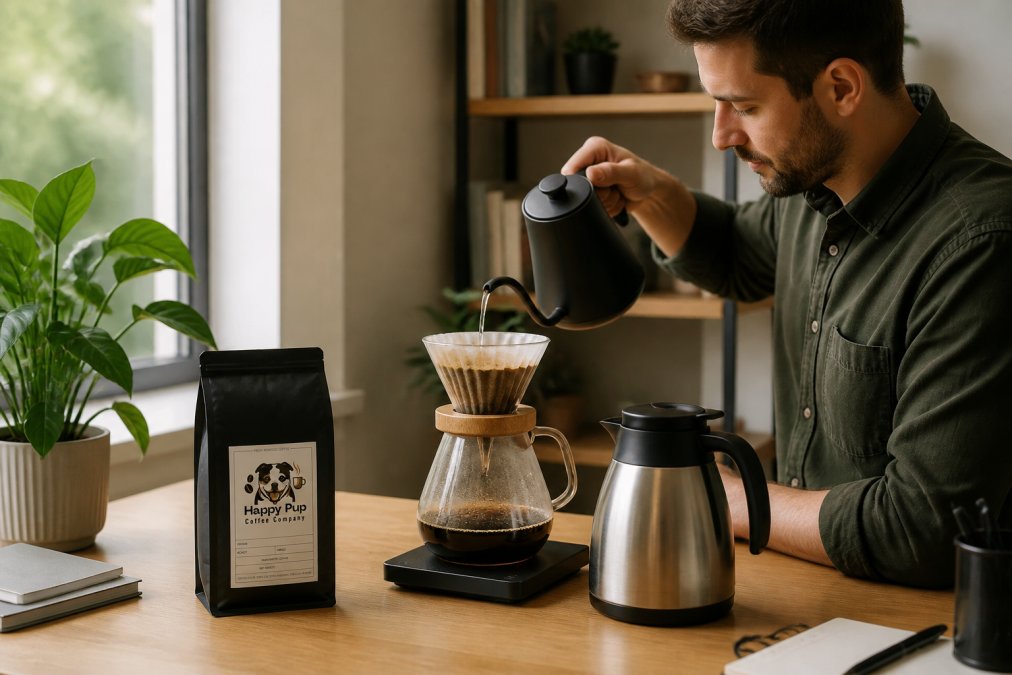
The best brewing method for your home office is the one that fits your space and time constraints. Thermal carafes, pour-overs, and single-serve brewers dominate home office setups because they're compact, require minimal counter space, and produce consistent results.
For professionals working from home, the thermal carafe is often the practical winner. You brew once in the morning and the carafe keeps coffee hot and fresh for 6-8 hours without a warming plate. This eliminates stale-coffee problems. A quality thermal carafe takes up minimal counter space and fits most standard coffee makers.
Single-serve capsule systems like Happy Pup Coffee Company's options excel if you value speed and consistency. Each capsule is sealed with no oxygen inside, preserving freshness. You brew one cup, drink it, and move on. No stale pot. No waste. This works especially well if you're managing variable energy needs.

Single-Origin vs. Blend: What Works Best
Single-origin coffees come from one specific region and reflect that region's terroir, altitude, soil, and climate. They tend to have distinctive flavor profiles with noticeable acidity and unique tasting notes. Single-origins are excellent for professionals who enjoy exploring flavor and have time to appreciate nuances.
Blends combine beans from multiple origins to create a consistent, balanced profile. A good blend smooths out extremes and creates coffee that tastes the same batch to batch. Blends are more forgiving with brewing technique and work well for people who want reliable, familiar flavor. Happy Pup Coffee Company's House Blend combines coffees from Central and South America for a smooth, clean cup with nutty and chocolate notes.
For home office work, the choice depends on your priorities. If you want reliable, familiar energy support, blends are practical. If you want to explore flavor and have time for brewing, single-origins reward attention. Many professionals keep both: a blend for weekday mornings when speed matters, and a single-origin for weekends.
Caffeine Intake Best Practices for Remote Work
Caffeine management for remote workers is different because your environment and break patterns are entirely self-directed. Without natural rhythm markers, it's easy to overconsume caffeine early and crash by afternoon. Front-load caffeine in the morning and taper through the day.
A medium roast cup (8 oz) contains roughly 95-200 mg of caffeine depending on brewing method and bean origin (peer-reviewed research). For most people, 200-400 mg of total daily caffeine supports focus without disrupting sleep (the FDA). A strong cup at 7 AM and a second cup at 10 AM provides sustained morning focus.
Happy Pup Coffee Company's Max Caf Blend uses high-caffeine Robusta beans, delivering elevated caffeine for extended focus sessions. Time these cups before 2 PM to avoid sleep disruption. A practical rhythm: high-caffeine coffee at 7-8 AM, a second cup at 10 AM, and switch to decaf or herbal tea after 2 PM.
How to Store Coffee Beans for Freshness
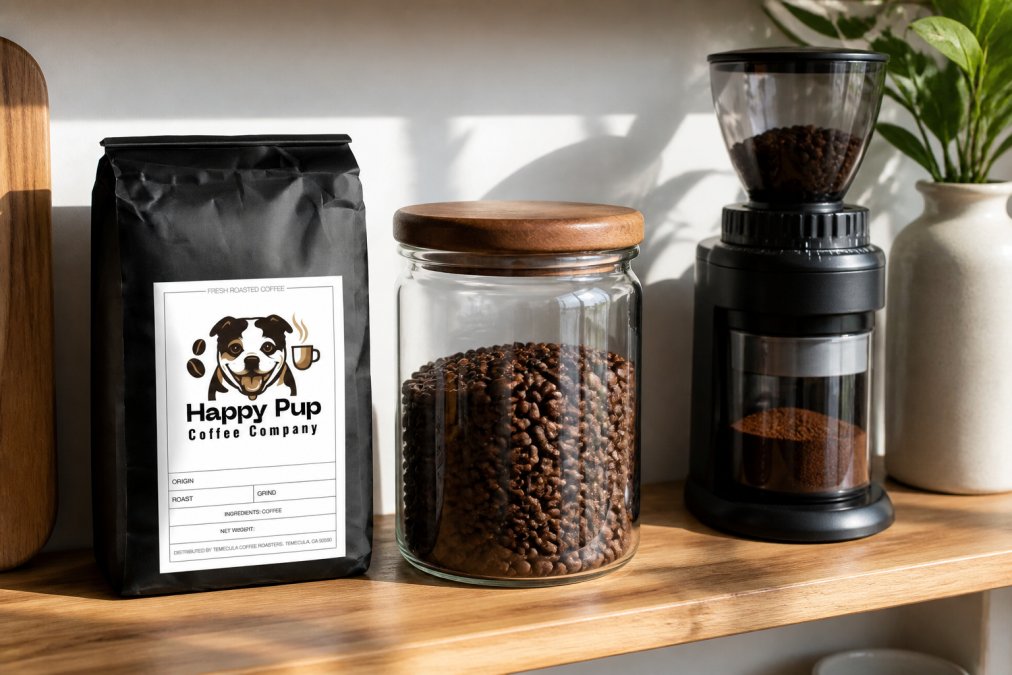
Coffee freshness degrades through oxidation, moisture, heat, and light. Whole beans stay fresh 2-3 weeks from roast date when stored properly. Pre-ground coffee stays fresh 1-2 weeks. The roast date matters more than the best-by date.
Store whole beans in an airtight container in a cool, dark place. A sealed glass jar works well. Avoid clear containers exposed to light and never store coffee in the refrigerator. A pantry shelf maintains stable temperature better than a counter near a window. If you buy larger quantities, freezing beans in airtight containers extends freshness to 3-4 months.
Happy Pup Coffee Company's single-serve capsules solve the freshness problem entirely. Each capsule is sealed with no oxygen inside, preserving flavor and freshness for months. For professionals who value convenience, sealed capsules remove storage variables.
Fresh coffee has brightness, clarity, and complexity. Stale coffee tastes dull and one-dimensional. If you're noticing flat flavor, your beans are past their prime or storage isn't airtight.
Sustainability and Ethical Sourcing in Your Daily Cup
Specialty coffee sourcing increasingly prioritizes sustainability and fair compensation for growers. Single-origin coffees often highlight their grower cooperatives and processing methods.
Happy Pup Coffee Company's Peru Coffee Pods source from Cooperativa Agricola de Servicios Norandino, a grower cooperative that ensures fair compensation and sustainable farming practices. Their Bali Coffee Pods come from smallholder farmers in Kintamani using hand-picked, wet-hulled processing on volcanic loam soil. Their medium roast blend uses both natural and washed processing techniques chosen for environmental friendliness.
For home office professionals who care about impact, specialty coffee offers transparency that mass-market coffee doesn't. You can trace beans to a specific region, grower, and processing method. This typically means buying from specialty roasters rather than mass-market brands.
Budget-to-Quality Ratio: Getting Premium Coffee Without Overspending
Premium specialty coffee costs more per cup than mass-market coffee, but the gap is smaller than most assume. A specialty medium roast at $29.99 for 12 oz yields roughly 12-14 cups at $2.15-$2.50 per cup. Compare this to café pricing ($4-$6 per cup) or mass-market coffee ($0.50-$1.00 per cup).
For remote workers, buying whole beans or capsules directly from specialty roasters beats grocery store pre-ground. Happy Pup Coffee Company's House Blend at $21.99 for 12 oz offers excellent value for a smooth, consistent daily drinker. Their single-serve capsules at $19.99 for 12 packs ($1.67 per cup) compete directly with café pricing while eliminating commute time.
The budget optimization strategy: buy a reliable blend as your daily drinker and reserve single-origin coffees for weekends. Single-serve capsules make sense if you value speed and consistency over cost. The Best Sellers Sample Pack at $24.99 lets you try multiple origins before committing to larger purchases.
| Budget Tier | Best Option | Cost Per Cup | Best For |
|---|---|---|---|
| Ultra-budget | Mass-market ground | $0.50-$0.75 | Caffeine only, no flavor priority |
| Budget-conscious | Happy Pup House Blend | $1.83 per 12 oz | Daily drinker, good value |
| Mid-range | Happy Pup Breakfast Blend or single-origins | $2.50 per 12 oz | Balance of quality and cost |
| Convenience-first | Single-serve capsules | $1.67-$2.50 per cup | Speed and consistency matter most |
| Exploration-focused | Sample packs | $4.17 per 2 oz | Try multiple origins affordably |
Selecting the best coffee for your home office comes down to matching three variables: your brewing setup, your daily energy pattern, and your budget. A medium roast blend offers the most reliable return on investment for professionals working remotely, it delivers consistent energy, works with any brewing method, and costs less than specialty single-origins. Happy Pup Coffee Company's Breakfast Blend and House Blend both nail this profile, offering freshly roasted specialty-grade coffee at accessible pricing with direct-to-doorstep delivery. If you value convenience, their single-serve capsules preserve freshness while eliminating prep time. The veteran-owned company's commitment to specialty-grade beans and sustainable sourcing means you're supporting a business that prioritizes quality at every step. Start with the Best Sellers Sample Pack to find your preference, then commit to a regular subscription that keeps your preferred coffee arriving before you run out. SHOP ALL COFFEE
Frequently Asked Questions
Q: What makes the best coffee for a home office different from regular coffee?
A: The best coffee for home office combines specialty-grade quality with practical convenience. Specialty coffee offers superior flavor profiles, controlled acidity levels, and consistent extraction, which keeps you mentally sharp during long work sessions. Unlike mass-market options, specialty-grade beans are roasted fresh and deliver the flavor notes and aroma that sustain focus. Single-origin and quality blends provide both the energy boost and the sensory experience that transforms your daily ritual into something worth pausing for.
Q: How do I know if coffee is actually fresh when it arrives at my door?
A: Fresh specialty coffee should have a roast date printed on the bag, not a 'best by' date. Look for beans roasted within 2-4 weeks of arrival. Check the seal: quality coffee arrives in bags with one-way valves that keep oxygen out while releasing CO2. When you open it, you should smell a strong, vibrant aroma immediately. Beans should feel dry and look glossy (not oily or dull). Freshly roasted whole beans ground just before brewing will taste noticeably brighter and more aromatic than stale coffee.
Q: Should I choose single-origin or blended coffee for my home office?
A: Single-origin coffees deliver distinct flavor profiles and showcase specific regions' characteristics, making them ideal if you enjoy exploring different taste notes and acidity levels. Blends offer consistency and balance, combining beans from multiple origins to create a smooth, reliable cup perfect for daily productivity. For home office work, many professionals rotate between both: single-origins on weekends for exploration, blends on weekdays for predictable performance. Your choice depends on whether you prioritize discovery or consistency.
Q: What's the best way to manage caffeine intake throughout a remote workday?
A: Spacing your coffee consumption helps maintain steady focus without afternoon crashes. Start with one cup (8-12 oz) in the morning to establish baseline energy. Wait 3-4 hours before your second cup to avoid caffeine jitters and sleep disruption. Limit total daily intake to 400mg (roughly 4 cups of specialty coffee), as higher amounts diminish returns on productivity. Avoid coffee after 2 PM to protect sleep quality, which directly impacts next-day focus. Pairing coffee with breakfast or a light snack slows caffeine absorption and extends the alertness window.
Q: How much does specialty coffee cost per cup compared to grocery store coffee?
A: Specialty coffee typically costs $0.75-$1.50 per cup when purchased in bulk or via subscription, compared to $0.30-$0.60 for mass-market grocery options. However, the flavor quality, freshness, and consistent extraction mean you need less coffee to feel the same effect. Single-serve capsules range from $0.33-$1.00 per serving depending on pack size, offering convenience without significant premium pricing. When you factor in reduced waste and superior taste that makes your work ritual more enjoyable, specialty coffee often delivers better value for remote workers who consume multiple cups daily.
This article was written using GrandRanker